
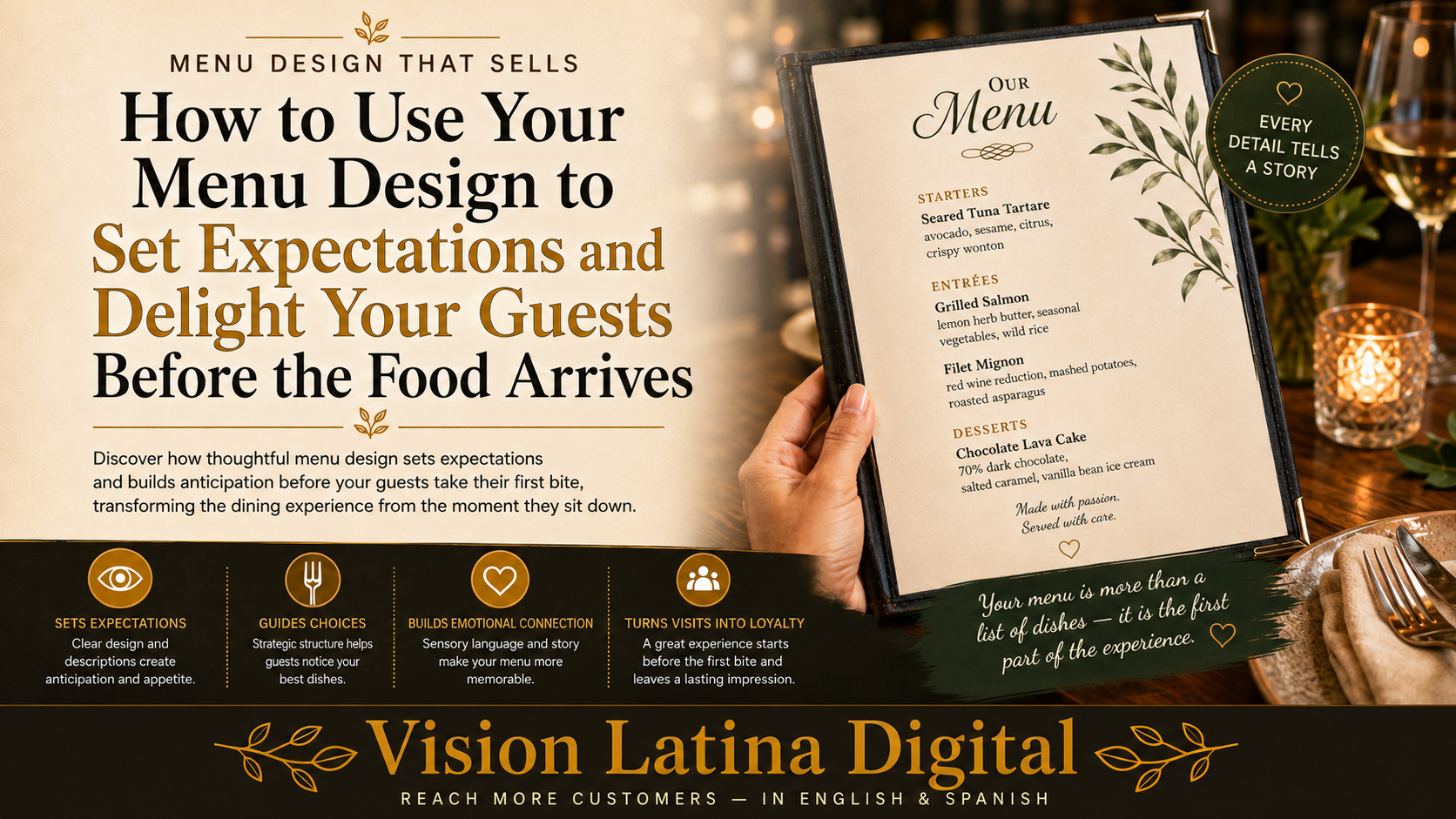
Imagine this: a couple walks into your restaurant for the first time. They've heard good things — maybe a friend recommended you, maybe they found you on Google. They sit down, look around, take in the atmosphere. And then the server places the menu in their hands.
In that moment, before a single dish has left your kitchen, your guest is already forming an opinion about your food.
That's the quiet power of menu design — and most restaurant owners underestimate it completely.
Your menu is not just a list of dishes and prices. It is the first real conversation you have with every guest who sits at your table. It shapes their mood, builds their anticipation, and either reassures them or leaves them confused. When it's done well, a great menu makes your food taste better before it even arrives. When it's done poorly, it creates doubt — and doubt is the enemy of delight.
This post breaks down exactly how thoughtful menu language, layout, and design can transform the guest experience at your restaurant — starting long before the first bite.
Why Menu Design Is a Customer Experience Tool, Not Just a Sales Tool
Most conversations about menu design focus on psychology tricks: put the high-margin item in the top right corner, use anchoring to make prices feel smaller, avoid dollar signs. And yes, some of that has merit.
But if you're a restaurant owner who truly cares about hospitality — the kind of care that brought your family's recipes to a dining room, that remembers regulars by name, that sends out a little extra because a table is celebrating — then you need to think about your menu differently.
Your menu is a hospitality tool first.
It's where you introduce yourself. It's where you tell guests what kind of place this is, what matters to you, and what they can look forward to. When a guest opens your menu and reads it, they should feel something — curiosity, warmth, hunger, excitement.
That feeling is not an accident. It's a design decision.
The Problem With Most Restaurant Menus
Here's a scene that plays out in restaurants every day: A guest opens the menu, scans it for 30 seconds, feels overwhelmed, and says to their partner, "I don't know, what are you getting?"
That moment of confusion is a failure of menu design — not of the food.
Common problems include:
- Too many choices with no guidance on what's special or recommended
- Generic descriptions like "grilled chicken breast with vegetables" that tell a guest nothing about flavor, texture, or what makes the dish worth ordering
- Inconsistent tone that swings between formal and casual with no clear personality
- Poor visual hierarchy that makes it hard to know where to look first
- No storytelling — nothing that connects the dish to a place, a person, or a memory
The result? Guests order the safest thing they recognize, feel underwhelmed when it arrives exactly as expected, and leave without a story to tell.
How to Write Menu Descriptions That Build Anticipation
This is where menu design gets exciting — and where small restaurants have a genuine advantage over chains.
You have a story. Use it.
1. Lead With Flavor and Feeling, Not Just Ingredients
Guests don't read menus to learn what's in a dish. They read menus to imagine eating it.
Compare these two descriptions:
- Pork ribs with chipotle sauce and rice
- Slow-braised pork ribs glazed with smoky chipotle — tender enough to fall off the bone, served with arroz rojo made from our grandmother's recipe
Both describe the same dish. But only one makes you lean forward in your seat.
Good menu language activates the senses. Words like smoky, crispy, slow-braised, bright, silky, tangy, rich do real work. They help guests taste the dish before it arrives, which means when it does arrive, they're primed for pleasure — not surprise.
2. Give Context Without Writing a Novel
A single line of origin or story can transform how a dish is received.
Examples:
- A family recipe from Oaxaca, passed down three generations
- Our take on the tlayuda we grew up eating at the market in Tlacolula
- Inspired by the street tacos we couldn't stop thinking about after a trip to Mexico City
These aren't just charming details. They give guests permission to trust you. They signal that this dish exists for a reason — that someone cared enough to bring it here.
3. Use Guiding Language to Reduce Ordering Anxiety
Many guests, especially first-timers, feel genuine anxiety about ordering. They don't want to choose wrong. They don't want to feel embarrassed asking questions.
You can ease that with small cues:
- "A great place to start"
- "Our most-loved dish"
- "Perfect for sharing"
- "A must if it's your first visit"
These phrases act as a trusted friend's recommendation — and they reduce the cognitive load of choosing, which makes guests feel more comfortable and more satisfied with whatever they order.
4. Match Your Voice to Your Restaurant's Personality
A neighborhood taquería in the Mission District should not sound like a fine-dining restaurant in Polanco. And vice versa.
Ask yourself: If your restaurant were a person, how would they talk? Warm and casual? Proud and refined? Playful and a little irreverent?
Your menu descriptions should sound like you — because consistency between your atmosphere, your service, and your menu creates a coherent experience. And coherence is what guests remember.
Layout and Visual Design: How Structure Shapes Experience
Even the best descriptions fall flat if the layout works against them. Here's what to pay attention to:
Limit Your Menu to What You Do Best
A long menu signals uncertainty — to your kitchen and to your guests. A focused menu signals confidence. It says: we know what we're great at, and that's what we're offering you.
If you have 60 items, consider whether 40 of them are truly earning their place. A shorter menu also means:
- Higher quality and consistency in the kitchen
- Faster ordering decisions for guests
- Lower food costs
- A clearer brand identity
Use Visual Hierarchy to Guide the Eye
Guests don't read menus like a book — they scan. So design for scanning:
- Section headers should be clear and easy to find
- Featured or signature dishes can be called out with a subtle visual marker or a brief note
- White space is not wasted space — it gives the eye a place to rest and makes everything feel less overwhelming
- Fonts and sizing should be legible without effort, especially in dim lighting
Consider the Physical Experience
How does the menu feel in your guest's hands? Is it clean? Does it look like it belongs in your restaurant? A laminated, food-stained menu at a beautifully decorated table creates dissonance — and dissonance undermines trust.
The physical menu is part of your restaurant's first impression. It deserves the same care as your table setting.
The Emotional Payoff: When It All Comes Together
When menu design is done well, something remarkable happens. Guests don't just order — they invest. They're curious about the dish they chose. They're excited to try it. They've already started enjoying the experience because your menu gave them something to anticipate.
And when that dish arrives and it lives up to what your words promised?
That's when a first-time guest becomes a regular.
This is the magic of using your menu as a customer experience tool. It's not manipulation. It's hospitality. It's saying to every person who sits at your table: I thought about you. I wanted this experience to feel good from the very beginning.
Quick Action Checklist: Is Your Menu Working for You?
Take 15 minutes this week and review your menu with fresh eyes. Ask yourself:
- Do my dish descriptions use sensory language that helps guests imagine eating each dish?
- Do I share any context, story, or origin for at least a few key items?
- Are there guiding phrases that help first-timers feel confident ordering?
- Does the tone sound like my restaurant — consistent and genuine?
- Is the menu easy to scan, with clear sections and good visual hierarchy?
- Does the physical menu look and feel appropriate for the experience I'm offering?
- Am I offering too many items, or just the right amount?
If you answered "no" to more than two of these, your menu has untapped potential — and fixing it doesn't require a big budget. It requires attention, intention, and a willingness to see your restaurant through your guest's eyes.
Ready to Give Your Menu the Attention It Deserves?
Start small. Pick your three best dishes — the ones that represent your restaurant's soul — and rewrite their descriptions this week. Use sensory language. Add a line of story. Read it out loud and ask: Does this make me want to eat this?
If it does, you're on the right track.
Your food is already great. Make sure your menu says so — before the plate ever hits the table.